




Collar Bolts: Selection, Applications & Installation Guide
Precision, durability, and long-term performance — the real markers of high-strength bolts built for industrial work.
A bolt that loosens within weeks rarely has a strength problem; it has a spacing problem. Collar bolts exist to close exactly that gap. A raised collar sits just beneath the head, spreading load, resisting rotation, and holding parts right where they were installed. Mechanical fasteners come in dozens of shapes, but few carry this much responsibility across structural frames and automotive assemblies. Reach for a standard bolt in the wrong spot, and something eventually loosens — that's usually where this component earns its place, within the wider family of industrial fasteners.
What Is a Collar Bolt?
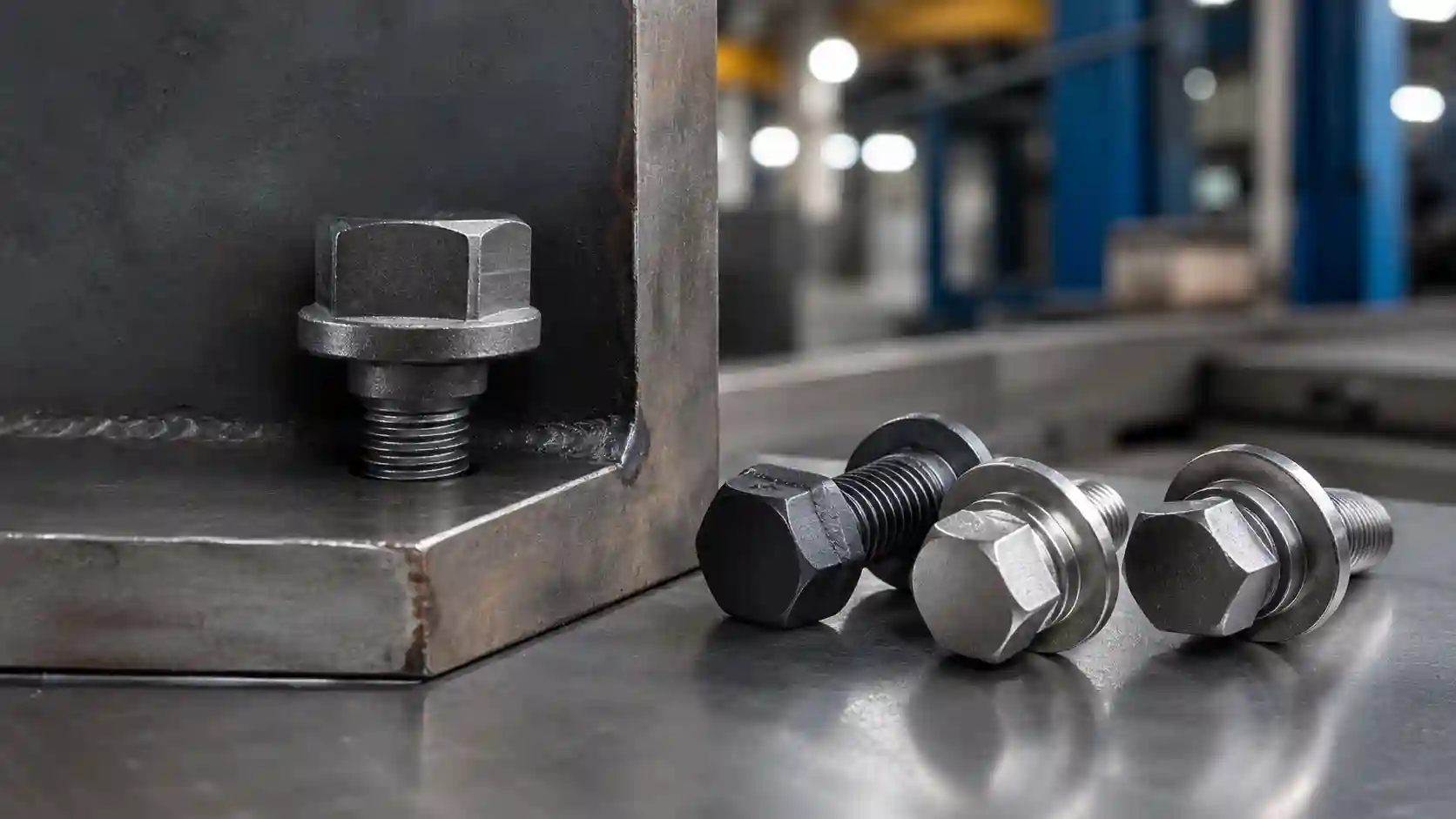
A Collar Bolt carries a wider, raised section beneath the head, essentially a washer forged into the shank rather than added afterward. Load spreads across that broader surface, keeping the bolt from cutting into softer base materials the way a plain shank bolt sometimes does. Torque it down, and the collar locks against rotation almost immediately — useful anywhere vibration never really stops. Forging, not machining from bar stock, is how most precision fasteners in this category get made; the process keeps grain flowing through the collar and shank, reinforcing exactly the spots where stress builds up.
Why Is It Important?
Loose joints rarely fail without warning. Vibration works a fastener free slowly, uneven load distribution cracks the base material, and corrosion quietly eats away at an exposed shank. Bolted joints depend on staying ahead of all three:
- Point-loading drops sharply once the wider bearing surface takes over
- Built-in rotation resistance means joints stay tight for longer
- Standoff spacing holds steady through welding and fitting
- Static structures and dynamic, load-bearing setups both benefit equally
Get the fastener choice right early, and most of the maintenance headaches that would follow never show up in the first place.
Types and Variants
No two collar bolts are built quite the same. Here's a rundown of common variants of these threaded fasteners:
- Hex collar bolts — the standard choice, tightened with an ordinary wrench
- Flange collar bolts, adding a washer-like base for wider load spread
- Bi-hex versions, built for high-torque machinery and automotive lines
- Collar eye bolts, meant for lifting and rigging rather than static joints
- Custom machined pieces, cut to whatever dimension a project calls for
Material choice matters just as much as shape. Go with carbon steel fasteners for general structural work where budget efficiency counts, or reach for stainless steel fasteners when the setting is outdoor or washdown-heavy and corrosion resistance can't be negotiated away. In between sits an alloy-based option: machine bolts offering higher tensile ratings for the tougher mechanical assemblies.
Features to Look For
A few things are worth checking beyond the diameter chart:
- Tensile rating first — high-tensile fasteners need to match or beat the joint's expected load
- Then finish: zinc plating or passivation gives you corrosion-resistant fasteners suited to humid or outdoor conditions
- Collar profile should sit flush, with no visible gap once torqued
- Standards compliance markings such as ISO 898-1 or EN 14399 are worth confirming
- Head style matters too, whether hex, bi-hex, or eye, depending on how much install access there is
Skip any one of these, and it tends to resurface later as a maintenance call rather than a flaw caught on paper.
Product Overview
Collar bolts built for serious industrial bolts duty start out as forged alloy or carbon steel, heat-treated to reach a target tensile band before finishing. Precision fastening here means tight tolerances on collar diameter and thread pitch, so a part performs consistently across an entire production run. Diameters typically start near standard machine-bolt sizes and scale up through heavier structural gauges. Buyers ordering at volume should ask for batch test certificates covering tensile and shear performance, not a general compliance statement alone.
Benefits
Some of the benefits are the following:
- Stress cracking around the fastening point drops when load spreads evenly
- Torque settings hold steady for months once rotation resistance kicks in
- Engineering applications from heat exchangers to structural frames all benefit
- Service intervals stretch longer on rotating equipment thanks to these heavy-duty bolts
- Field inspection gets easier — a properly seated collar is visible at a glance
|
FACT A collar bolt torqued correctly spreads clamping force across roughly 30 to 40 percent more surface area than a standard hex bolt of matching diameter. |
Applications and Use Cases
Wherever spacing and rotation resistance both carry weight, collar bolts tend to show up:
- Inside heat exchangers, holding removable tube bundles without disturbing the seal
- Across structural and automotive assemblies that need exact standoff spacing
- In two-piece lockbolt connections, where the collar swages into the pin for a permanent, vibration-resistant joint
- On welding fixtures, keeping consistent space between base metal and the part being attached
- High-volume, repeatable work across general manufacturing applications
A spec sheet only tells half the story; batch-to-batch consistency is what keeps a production line running, and one mismatched shipment is enough to stall it.
|
TRIVIA Aerospace assembly is where collar-style lockbolt fastening actually got its start, since a bolt working loose mid-flight was never going to be an acceptable risk. |
Comparison at a Glance
Understand the differences with the following table:
| Fastener Type | Best Suited For | Key Strength | Common Material |
|---|---|---|---|
| Collar Bolts | Spacing-critical, rotation-resistant joints | Rotation resistance and load spread | Alloy or carbon steel |
| Hex Bolts | General-purpose assembly work | Simple, fast installation | Carbon steel |
| Flange Bolts | Broad, even load distribution | Integrated washer-style bearing surface | Alloy steel |
| Socket Head Bolts | Tight or recessed mounting spaces | Compact, low-profile head | Alloy steel |
| Allen Bolts | Precision machinery assembly | Controlled, repeatable torque application | Stainless or alloy steel |
Expert Tips and Buying Guide
A handful of habits separate a smooth order from a frustrating one:
- Double-check the collar profile against the mating hardware before committing to a full batch
- Ask for material test certificates covering every production run, start to finish
- Lock in torque specifications with the supplier's engineering team ahead of installation
- Reputable collar bolt manufacturers in India generally offer both standard and custom-machined options
- Established collar bolt wholesalers in India tend to support bulk orders with dependable, consistent lead times
A supplier fluent in construction fastening and mechanical fastening usually saves a good deal of back-and-forth during procurement.
About AFT
AFT (Anchorite Fixing Technology) is the best industrial fastening solution. We are the most trusted and reliable partner for many businesses. Since 2017 we have been providing solutions to various sectors. Our expertise is in providing the companies with high-performance and customized construction fastening solutions. We offer anchor fasteners and anchor products that are used in modern industries. AFT focuses on delivering reliable and durable fastening systems that ensure safety and performance. We provide sustainable solutions that meet the modern industrial demands. AFT combines advanced technology with industry expertise to provide efficient solutions. If you are ready to source high-quality fastening solutions, then you are at the right place. We also serve nuts and bolts, anchor-type products, and rods that will meet your needs perfectly.
FAQs
1. Where are collar bolts applied industrially?
Ans: Collar bolts find applications where it is necessary not only to attach two items but also ensure additional requirements such as proper spacing or positioning. Due to their elevated collar, it becomes possible to use a particular surface for these purposes. Collar bolts are applied in machinery, fixtures, structures, automotive parts, etc. and exposed to vibration.
2. Why are collar bolts different from regular bolts?
Ans: The major distinctive feature is an elevated collar under the head of the bolt. While a common bolt depends on the washer or the surface of the element in terms of load distribution, a collar bolt is characterized by a combination of fastening function and a built-in bearing and/or locating element.
3. What material is the best for collar bolts?
Ans: A proper material selection largely depends on the conditions of work and load applied. Carbon steel may be sufficient in case of ordinary usage while stainless steel is preferable when it comes to exposure to water and possible corrosion. Alloy steel is preferable in case of heavy duty.
4. What should one pay attention to buying collar bolts?
Ans: Among others, it is necessary to consider collar diameter, collar length, thread dimensions, thread engagement, head type, material, and required strength. One may also need to look for a relevant standard and surface treatment. In the case of bulk purchase, it is recommended to ask for consistent dimensional characteristics and documentation of material.
5. Are collar bolts appropriate in vibrating machinery?
Ans: Collar bolts may become appropriate for the usage in vibrating machinery depending on their design and specifications. However, vibration resistance depends not only on the collar itself but also on the proper torque, joint design, thread engagement, and locking in certain cases.
6. Is it possible to manufacture collar bolts in bulk form or custom-machining form?
Ans: Yes. Apart from the normal hex, flange, and bi-hex varieties, it is possible to have custom machined collar bolts to suit project requirements when none of the standard sizes is available. Most reliable manufacturers and distributors in India will support both options.
Conclusion
Collar bolts will never be the flashiest fastener on a shelf, but engineering fasteners like these keep everything from heat exchangers to structural frames stable well past installation day. Getting the type, material, and finish right at sourcing tends to pay for itself many times over, long before the first maintenance cycle comes due.
| Looking for collar bolts that hold up to industrial-grade standards? Get in touch with AFT to source precision-engineered fasteners built around your project's exact requirements. |