




How to Choose Reliable Bolt Manufacturers for Industrial Applications
Bolts fail quietly, until they don't. A stripped thread or the wrong grade rarely shows up on day one; it turns up months into service, usually at the worst possible time, in a machine housing or a structural joint nobody's watching closely. Comparing price sheets alone won't catch that risk. Testing records, tolerance control, proper documentation — this is what actually separates dependable Bolt Manufacturers from suppliers who just happen to stock fasteners. Here's what to check before an order goes out with any industrial bolt manufacturers supplier — skipping it tends to cost more down the line.
Why Choosing the Right Bolt Manufacturer Matters
Manufacturer choice matters because a bolt sits exactly where load, vibration, and material science collide. Get it wrong and joint integrity goes with it — corrosion creeps in, threads strip, connections work loose under stress. Reliable Bolt Manufacturers keep that risk contained, mostly because process control happens long before anything ships. Fewer failures. Fewer emergency shutdowns. Fewer maintenance crews pulled off other jobs. Industrial bolts built to spec also age predictably, so engineers plan replacement cycles instead of reacting to them. None of this shows up on a price list. It shows up in quality bolts performance, years into a project, once nobody remembers which supplier got picked.
Key Factors to Consider When Choosing Bolt Manufacturers
A catalog and a quote sheet only get you halfway there. What separates dependable Bolt Manufacturers from a supplier who simply moves stock comes down to technical capability, documentation, and consistency, weighed together rather than checked off one at a time. The checklist below covers what a genuine bolt supplier should actually clear.
Material Quality and Bolt Grades
Not every bolt needs the same grade or coating. Load, temperature, and corrosion exposure decide that, not habit and not whatever's cheapest this month. Bolt material is where that decision actually starts.
- Match bolt grades to the load class the design actually calls for
- Carbon steel, alloy steel, or stainless? That depends on exposure
- High strength bolts should ship with mill test certificates, no exceptions
- Hardness and tensile ratings need checking against the spec, not assumed from a datasheet
|
TRIVIA A torque-tension mismatch on a single structural bolt has shown up as a contributing factor in more than one historic engineering failure investigation. Grade verification isn't a formality; it's the line between passing inspection and starting one. |
Manufacturing Quality and Precision
Two boxes of the same bolt shouldn't feel like two different products.
- Thread tolerances cannot drift order to order
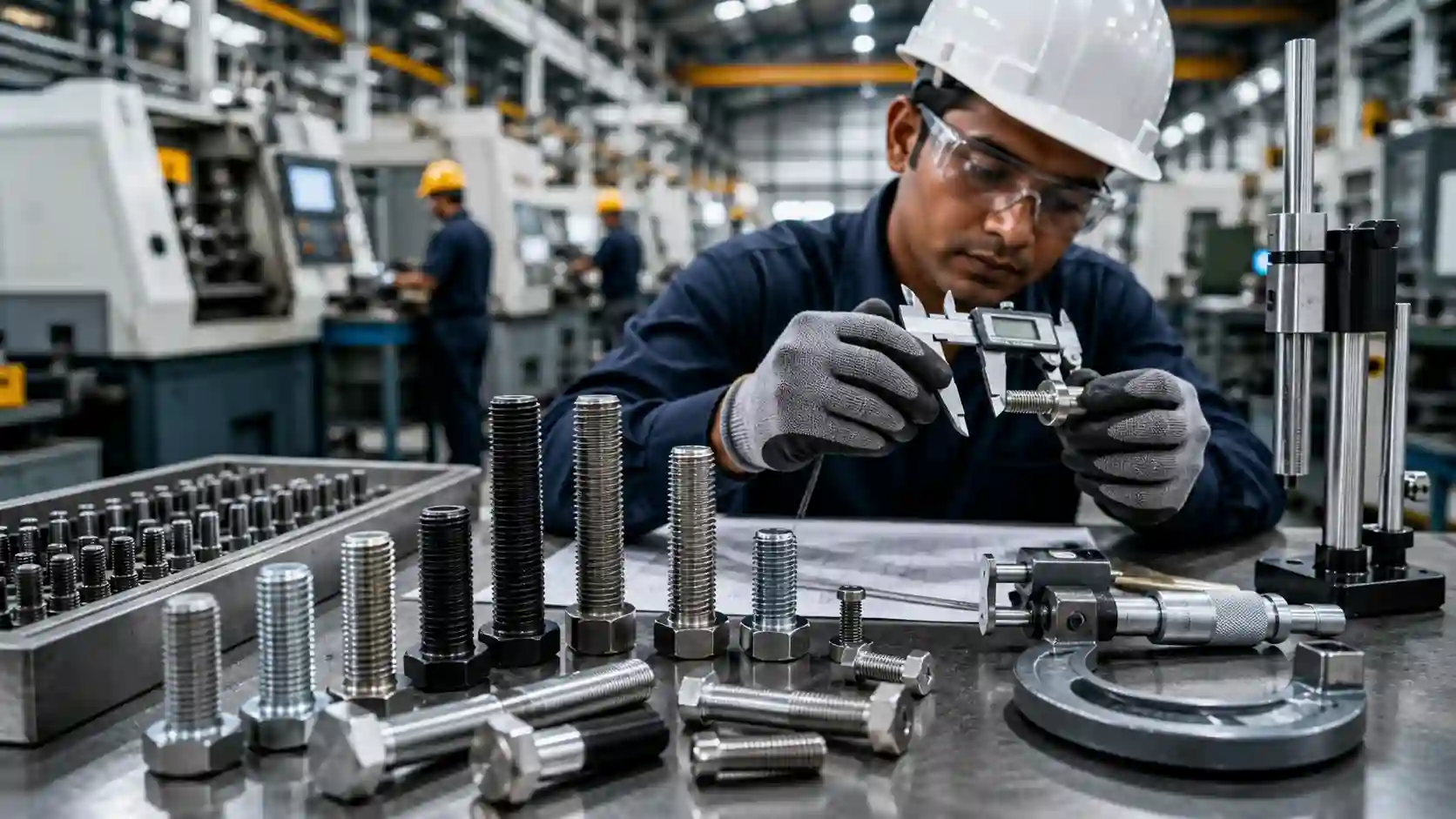
- Precision bolts need calibrated CNC or forging equipment behind them, not manual guesswork
- Does the supplier run in-house inspection with go/no-go gauges and coordinate measuring machines?
- Surface finish and plating uniformity affect fit as much as they affect corrosion life
- Sampling reports confirm bolt manufacturing consistency at scale, and rejected units get tracked, not quietly reworked
Compliance With Industry Standards
Nobody should have to reverse-engineer quality on their own. Standards exist for exactly that reason.
- Products should meet IS, DIN, or ASTM specifications relevant to the project at hand
- Standard bolts built to recognized codes make approvals and audits faster
- DIN bolts and IS standard bolts should carry markings that confirm origin and grade at a glance
- Traceability documents link raw material batches to finished parts
- Third-party test reports carry more weight than in-house claims alone
|
DID YOU KNOW? The metric thread profile used on bolts worldwide traces back to a 19th-century engineering standard. It was later refined into the ISO metric system that still appears on drawings today. |
Range of Bolts Available
A thin catalog says more about a manufacturer than any brochure does.
- Hex, carriage, eye, anchor: does the range cover what a project actually needs?
- Wide types of bolts coverage means fewer supplier switches mid-project
- Industrial bolts should span several diameters and thread pitches, not just the common sizes
- Bolt sizes should reach into non-standard or metric-imperial crossover ranges too
- Zinc, hot-dip galvanized, black oxide finishes ought to be readily on hand
Customization Capabilities
Off-the-shelf rarely fits an OEM project exactly.
- Can custom bolts be produced for non-standard lengths or head styles?
- Customized bolts with project-specific coatings or threading cut down on assembly rework later
- Small prototype runs before full production — a capable industrial bolt manufacturer should offer this without hesitation
- Turnaround on custom tooling matters just as much as the quote itself when deadlines are tight
Production Capacity and Bulk Supply
Running out mid-order isn't an option on a live project.
- Monthly production capacity needs to match the project's real volume, not the volume on paper
- Bulk bolts orders should hold consistent quality batch after batch, without drift
- Raw material inventory planned ahead of demand spikes — that's what separates a dependable bulk bolt supplier from one that's always catching up
- Lead times during peak season matter more than the standard quoted timeline ever does
Common Industrial Applications of Bolts
Bolts play their role whenever two elements require a connection which is removable in the future. Structural steel frames, precast concrete slabs, and machine housings make use of industrial bolt applications designed specifically for a particular stress condition.
- Construction bolts anchor foundations and hold precast connections together
- Engineering bolts secure pumps, compressors, and rotating machinery
- Infrastructure projects, bridges, pipelines, support structures, lean on the same principle at a larger scale
- Equipment housings need vibration-resistant fastening too
Requirements for material and grade vary with each usage, and that is precisely the reason why a blanket purchase decision hardly ever applies across the entire facility.
Questions to Ask a Bolt Manufacturer Before Ordering
Five minutes on the phone before the order goes in can save weeks of rework.
- What material grades and certifications back this bolt manufacturer's production line?
- Can test reports be shared for the specific batch being ordered?
- What sizes, finishes, and thread types sit in stock right now?
- Is customization on the table, and what is the minimum order quantity?
- How are bulk bolt orders handled once demand spikes?
Reliable bolt suppliers won't dodge any of that. Vague answers are the warning sign worth noticing.
Why Quality Should Come Before Price
A cheap quote rarely reflects what a fastener costs over its working life. Premature failure means downtime nobody planned for, replacement parts ordered under pressure, sometimes a safety incident that dwarfs whatever got saved upfront. Quality bolts cost more on day one. They also cut maintenance frequency and keep equipment warranties intact — reliable bolts mean fewer surprises during inspection, and fewer stressful audits. For industrial fasteners sitting in load-bearing or safety-critical spots, unit price was never the real comparison. Total cost across the equipment's life is.
| Factor | Unverified Low-Cost Supplier | Reliable Certified Manufacturer |
|---|---|---|
| Material Testing | Rarely documented | Mill certificates on file |
| Standards Compliance | Inconsistent from batch to batch | IS / DIN / ASTM verified |
| Batch Consistency | Changes order to order | Held within controlled tolerances |
| Customization | Little to no flexibility | Project-specific options available |
| After-Order Support | Minimal follow-through | Full documentation & traceability |
Choose the Right Bolts for Your Industrial Requirements
Verified material grades. Documented compliance. A process that holds steady batch after batch — that's what a dependable fastening partner actually looks like, and it's what AFT's bolt range is built around. Standard hex bolts or custom bolts engineered for one specific assembly, working with Bolt Manufacturers who document every stage of production takes the guesswork out of procurement. Get in touch to talk through specifications, request documentation, or line up a quote for the next order.
Frequently Asked Questions
1. What should I check before choosing a bolt manufacturer?
Ans: Check material certifications first, then grade documentation and manufacturing quality control. Standards compliance and test-report availability on request matter next. So does batch-to-batch consistency, and how much production capacity actually backs the claim. Reliable Bolt Manufacturers hand over traceability records — raw material through to finished fastener — without being asked twice.
2. Which bolt materials are commonly used for industrial applications?
Ans: Three materials cover most industrial needs: carbon steel, alloy steel, and stainless. Which one fits depends on load, environment, and corrosion exposure — stainless for humid or chemical settings, alloy steel for higher tensile demands. Industrial bolt materials get chosen for the application at hand, never picked from one default and applied everywhere.
3. Can bolt manufacturers provide customized bolts?
Ans: Yes. Established manufacturers support custom lengths, head styles, threading, and coatings built around specific project needs. Custom bolt manufacturers often run a small prototype batch first, just to confirm fit before full production starts. Minimum order quantities and lead times vary by supplier — worth asking about early, before specifications get locked in.
4. How do I select the correct bolt grade?
Ans: Load, mating material, and environmental exposure, moisture, temperature swings, decide the grade, not guesswork. Engineering drawings usually specify a required bolt grades rating, and that should drive sourcing directly. A manufacturer's technical team can step in when the spec is unclear, matching grade to application without over-engineering the joint.
5. What is the difference between standard and high strength bolts?
Ans: Standard bolts handle general-purpose fastening, where loads stay moderate and predictable. High strength bolts exist for structural or safety-critical joints — same dimensions, higher tensile and yield ratings. The real question isn't which category a bolt falls into on paper. It's how much stress the connection will actually carry.
6. How can I verify a bolt supplier's quality before placing a bulk order?
Ans: Mill test certificates, third-party inspection reports, and consistent IS or DIN marking on sample pieces are worth requesting upfront. Most relationships with bulk bolt suppliers start small — a trial order before scaling up. Site visits or virtual audits of the production facility add one more layer of confidence before committing to volume.