




What Is a Wedge Anchor? Features, Applications & Benefits
A complete guide to wedge anchor bolts, how they work, and how to pick the right wedge type anchor fastener for demanding concrete fixing jobs
Watch a steel column go up, or a handrail get bolted into a concrete slab, and there's a decent chance a wedge anchor is doing the quiet work underneath. Nobody notices it. That's kind of the whole point. Good fastening isn't supposed to draw attention — a properly installed wedge anchor bolt just sits there and holds, year after year, no fuss. This piece covers what it is, how it actually works, where you'll find it on-site, and what to check before you buy — whether that's for a factory floor or a ten-storey commercial build.
What Is a Wedge Anchor?
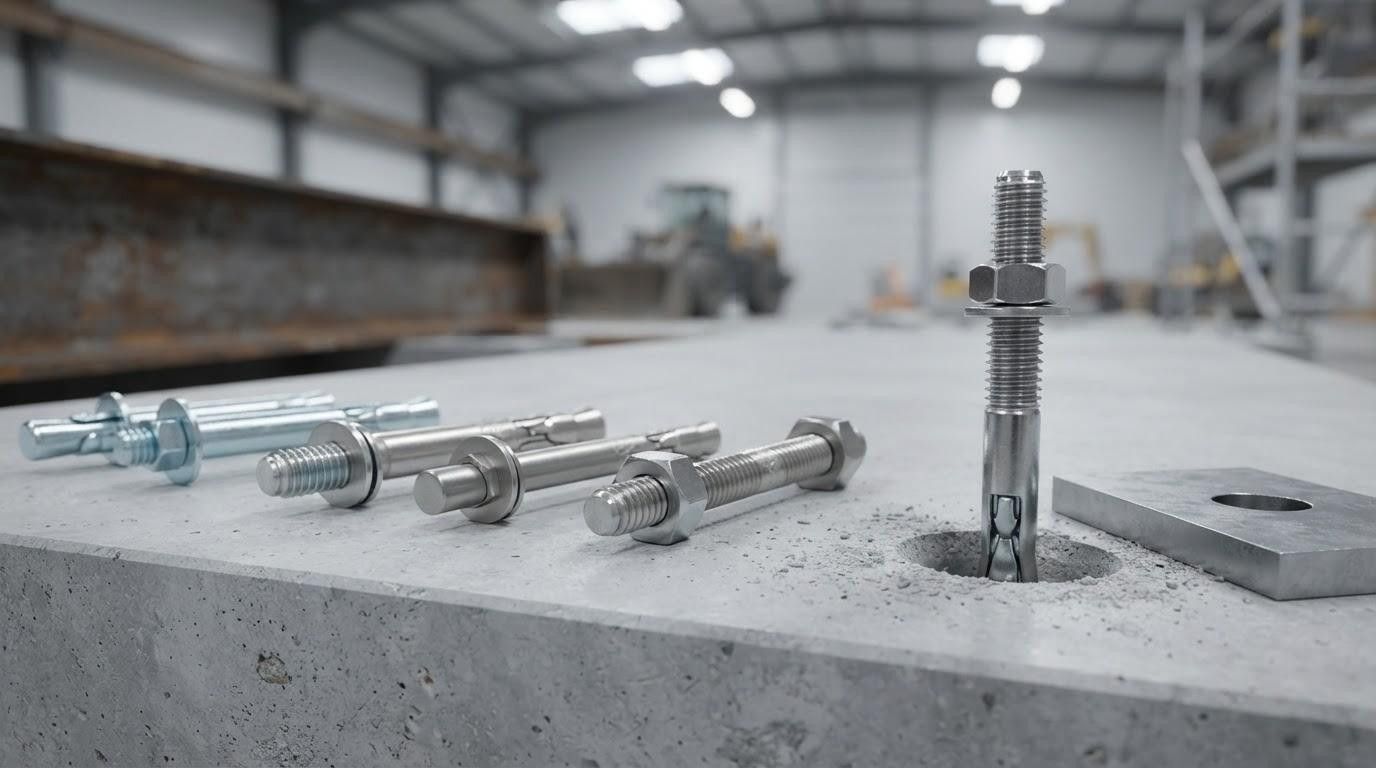
At its core, a wedge anchor is a mechanical expansion fastener made for permanent, load-bearing fixings in solid concrete. Three parts, really — a threaded stud, an expanding clip near the buried end, and a nut-and-washer assembly up top. Drop it into a pre-drilled hole, tighten the nut, and the clip pushes outward against the hole's walls. Simple mechanism. What you get is a tight grip that fights both straight-pull force and sideways shear.
No glue, no resin, no cartridges — that's the difference with a concrete wedge anchor. It works through friction and expansion alone, so there's nothing to cure and nothing to wait on before the connection can take load. Probably why it's stayed one of the go-to fastening choices on construction sites for so long. Experienced Wedge Anchors Suppliers in India tend to understand load requirements as well as stock — that combination saves headaches later.
Why Is It Important?
Picking the wrong fastener isn't a minor slip-up — it goes straight to the safety and lifespan of whatever's being held up. A few reasons a wedge anchor bolt earns its place on-site:
- Handles heavy static and dynamic loads without loosening over time
- Performs reliably under vibration, wind load, and thermal movement
- Offers immediate holding strength right after installation, with no cure time
- Reduces on-site delays compared to chemical-set alternatives
- Suits both indoor structural work and exposed outdoor fixings
Trivia: That expansion-clip mechanism didn't start in construction — it goes back to old mining and tunnelling rigs, decades before builders picked it up.
Types and Variants
Not every wedge type anchor fastener is cut from the same material, and honestly, that choice ends up deciding how well it ages:
- Carbon steel — economical and dependable for dry, indoor environments
- Stainless steel wedge anchor — corrosion-resistant, suited to humid, coastal, or chemical-exposure zones
- Alloy steel, zinc-plated — engineered for heavy structural and machinery-grade loads
- HCR-coated variants — built for aggressive industrial or marine conditions where standard coatings fall short
Features to Look For
A dependable wedge anchor installation actually starts before the drill ever touches concrete. It starts with picking the right product for the site. A few things worth checking:
- Consistent thread quality and reliable clip geometry
- Verified tensile and shear load ratings for the intended application
- Corrosion protection suited to the specific environment
- Compliance with recognised structural testing and safety standards
- Compatibility with the base material's strength class and condition
Did You Know?: A single wedge anchor bolt, once fully expanded into cured concrete, can often be rated to hold well beyond its own weight in tensile load.
Product Overview
Most manufacturers stock a wedge anchor in a whole range of diameters, lengths, and material grades — each one built for a particular load class. Basic carbon steel does the job for general indoor fixing. A stainless steel wedge anchor, though, tends to get reserved for jobs where long-term corrosion resistance matters more than saving a bit upfront. The better production lines pull-test every batch — embedment depth, torque tolerance, expansion consistency — before anything leaves for a job site. If you're sourcing a wedge anchor for a large project, ask for that test data. Don't just eyeball it.
Benefits of Using Wedge Anchors
Here are the advantages of using wedge anchors by reliable Wedge Anchors Dealers in India:
- Strong, permanent hold in solid, cured concrete
- No curing, no waiting — the connection can be loaded right away
- Standard drilling tools are all you need for installation
- Comes in a wide range of diameters and lengths
- Cheaper than most specialty chemical anchoring systems
- Long service life, and it barely needs any upkeep
Applications and Use Cases
A concrete wedge anchor turns up in more places than people usually assume — quietly holding structures together across all sorts of industries:
- Structural steel column and base plate connections
- Machinery foundations and heavy equipment mounting
- Handrails, guardrails, and safety barrier installations
- Façade support brackets and sub-frame fixings
- HVAC ductwork, cable trays, and pipe rack supports
- Highway crash barriers and metro infrastructure fittings
Fact: Embedment depth alone can swing holding capacity more than almost any other installation factor — more, even, than diameter.
Comparison Table — Anchor Types at a Glance
| Anchor Type | Working Principle | Best Suited For | Load Behaviour |
|---|---|---|---|
| Wedge Anchor | Mechanical expansion via clip | Solid, cured concrete | High tensile and shear, instant load |
| Sleeve Anchor | Sleeve compresses on expansion | Concrete, brick, and block | Moderate load, versatile across substrates |
| Chemical Anchor | Resin-based bonding | Cracked concrete, close-edge fixing | High load, but needs cure time |
| Drop-In Anchor | Internally threaded shield | Flush, removable fixings | Medium load, reusable threading |
Expert Tips / Buying Guide
Getting the spec right on paper means nothing if the wedge anchor installation itself is sloppy. A few pointers that actually hold up on-site:
- Drill to the exact diameter and depth specified — don't oversize it, ever
- Clear out the dust before inserting the anchor; leftover debris kills the grip
- Tighten to the recommended torque — not by feel, not by guesswork
- Match diameter and embedment to the real load, not what you did last time
- Buy from wedge anchor manufacturers in India that actually pull-test their batches
And established Wedge Anchors Wholesalers in India? They make bulk sourcing for big infrastructure projects a lot less painful, without the batches turning inconsistent. Stick with one supplier chain where you can — repeat batches just behave more predictably.
AFT
AFT (Anchorite Fixing Technology) is the best industrial fastening solution. We are the most trusted and reliable partner for many businesses. Since 2017 we have been providing solutions to various sectors. Our expertise is in providing the companies with high-performance and customized construction fastening solutions. We offer anchor fasteners and anchor products that are used in modern industries. AFT focuses on delivering reliable and durable fastening systems that ensure safety and performance. We provide sustainable solutions that meet the modern industrial demands. AFT combines advanced technology with industry expertise to provide efficient solutions. If you are ready to source high-quality fastening solutions, then you are at the right place. We also serve nuts and bolts, anchor-type products, and rods that will meet your needs perfectly.
FAQs
1. What is a wedge anchor used for?
Ans: A wedge anchor is used for permanent, heavy-duty fixings into solid concrete — think structural steel connections, machinery bases, handrails, and façade brackets. It works through mechanical expansion, gripping the concrete tightly the moment it's tightened, with no curing wait involved.
2. How does a wedge anchor bolt actually hold in concrete?
Ans: It relies on a threaded stud with an expanding clip near the tip. As the nut tightens, the clip spreads against the drilled hole's walls, creating strong mechanical friction. That grip resists both pull-out and shear forces, which is why it performs so well under load.
3. When should I choose a stainless steel wedge anchor over carbon steel?
Ans: Go stainless steel wherever corrosion is a real risk — coastal sites, humid plants, or areas with chemical exposure. Carbon steel works fine for dry, indoor structural fixing, but stainless steel wedge anchor variants last far longer once moisture or chemical contact enters the picture.
4. What matters most during wedge anchor installation?
Ans: Drilling the correct hole diameter and depth matters most, followed closely by cleaning out dust before insertion. Skipping either step weakens the anchor's grip significantly. Torque should also match the manufacturer's recommendation rather than being tightened by feel or guesswork alone.
5. Can a wedge anchor be used in cracked or damaged concrete?
Ans: Not reliably — wedge anchors are designed for solid, cured concrete where the expansion clip can bite into intact material. Cracked or weakened concrete reduces holding capacity significantly. For cracked-concrete conditions, a chemical anchor system is usually the more dependable choice.
6. How do I choose a reliable supplier for bulk wedge anchor orders?
Ans: Look for wedge anchor manufacturers in India that pull-test every batch and share load data upfront. Established suppliers, dealers, and wholesalers also tend to keep consistent stock across sizes and material grades, which matters a lot when large infrastructure projects can't afford mismatched deliveries.
Conclusion
A wedge anchor looks small in the grand scheme of a project, sure, but it's carrying real structural weight — sometimes literally. Carbon steel for the routine indoor jobs, a stainless steel wedge anchor for anything near the coast — either way, get the spec, the material, and the installation right, and it'll hold for decades. Get it wrong, and you're back on-site sooner than you'd like.
| Need certified wedge anchors for a demanding job site? Contact to our team of AFT for technical guidance and bulk sourcing support. |